Wednesday, May 9, 2012

Great Britain and BSE


The United States had seen the effects Mad Cow disease had on the economy o Great Britain which likely prepared the United States for all cases seen in the states. BSE in Great Britain was an awful experience. The first cause of Mad Cow appeared in the mid 1980’s. By 1993 over 1,000 cases of BSE were being reported every week! By this time there were nearly 160,000 infected cows in the country, which was around 50% of the dairy cattle. The situation only worsened once people began eating the infected meat.

"EFFECT ON ECONOMY." ThinkQuest. Oracle Foundation. Web. 09 May 2012. <http://library.thinkquest.org/03oct/01272/id32.htm>.

The Scare


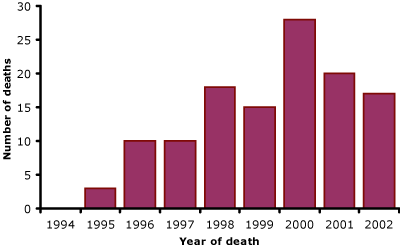
Now that people were eating the contaminated meat there was a new scare. It was called Creutzfeldt-Jakob disease (vCJD). This disease was found in those who had consumed infected meats. It affected humans the same way that BSE affected cattle; it was a degenerative disease that harmed the nervous system. The continent of Europe went into a panic. Less people began consuming beef. This loss of consumption dropped sales 30%.Farmers were not able to sell their beef products which lead to a 40% drop in beef production. Over 1.3 million cattle had to be killed in Great Britain alone. The beef industries crashed and more than 45,000 jobs were lost. In total, vCJD caused 167 deaths.

Link: http://www.accessexcellence.org/WN/NM/madcow96.php

"MAD COW DISEASE The BSE Epidemic in Great Britain." MAD COW DISEASE: THE BSE EPIDEMIC IN GREATBRITAIN. Web. 09 May 2012. <http://www.accessexcellence.org/WN/NM/madcow96.php>.

Japan Bans


In 1996, after cases of Mad Cow disease appeared in Great Britain, Japan stopped importing animal feed from the country. This might sound familiar, in 2001, Japan banned beef and processed beef imports from 18 countries world wide. An interesting fact, Japan was the first country outside of Europe to report a case of a cow infected with the BSE virus.


Photo Credit: http://www.kearneyhub.com/news/local/article_2d0b3a56-8fa6-11e1-ba7a-0019bb2963f4.html
Link: http://library.thinkquest.org/03oct/01272/id32.htm
"EFFECT ON ECONOMY." ThinkQuest. Oracle Foundation. Web. 09 May 2012. <http://library.thinkquest.org/03oct/01272/id32.htm>.

The Statistics


Here are a few statistics provided by the USDA’s Economic Research Service:
U.S. beef exports (commercial carcass weight and value):
    2002: 2.447 billion pounds, $2.629 billion
    2003: 2.518 billion pounds, $3.186 billion
    2004: 460 million pounds,   $631 million
    2005: 697 million pounds,   $1.031 billion
    2006: 1.132 billion pounds, $1.617 billion
    2007: 1.434 billion pounds, $2.187 billion 
    2008: 1.996 billion pounds, $3.014 billion 
    2009: 1.935 billion pounds, $2.909 billion
    2010: 2.300 billion pounds, $3.839 billion
    2011: 2.788 billion pounds, $5.042 billion
The sudden appearance of Mad Cow disease may have affected the dramatic price drop from 2003 to 2004.
U.S. beef production (commercial carcass weight):
    2002: 27.09 billion pounds 
    2003: 26.24 billion pounds  
    2004: 24.55 billion pounds
    2005: 24.68 billion pounds
    2006: 26.15 billion pounds
    2007: 26.42 billion pounds 
    2008: 26.56 billion pounds 
    2009: 26.07 billion pounds
    2010: 26.41 billion pounds 
    2011: 26.29 billion pounds
After the appearance of Mad Cow disease in 2003, production decreases.
U.S. beef exports as percent of production: 
    2002: 9.0 percent
    2003: 9.6 percent
    2004: 1.9 percent
    2005: 2.8 percent
    2006: 4.4 percent
    2007: 5.4 percent
    2008: 7.1 percent 
    2009: 7.4 percent 
    2010: 8.7 percent 
    2011: 10.6 percent
Finally, we can see the impact Mad Cow disease had on exports, from 2003 to 2004, dropping nearly 8%. 

Link: http://www.ers.usda.gov/news/BSECoverage.htm
"U.S. Beef and Cattle Industry: Background Statistics and Information." Background Statistics: U.S. Beef and Cattle Industry. Web. 09 May 2012. <http://www.ers.usda.gov/news/BSECoverage.htm>